3 ways to improve your microbiome with food

Wow, we’re getting to the end of August – Microbiome month at Eat Well Live Well.

We started with a look at what the microbiome is (read the post here if you missed it).

In this video I then explained how your microbiome is different from others.

Last week I explained how your microbiome affects your endometriosis.

So this week we finally get to the good part: I'll give you 3 ways to improve your microbiome with food.

Because here’s the thing: the bacteria in your gut eat what you eat. And the different bacteria thrive on different types of food. Which means you can starve the bad bacteria by eating none (or less) of the foods they love, and grow the colonies of good bacteria by eating more of what they love.

Sounds simple, doesn’t it?

I’m a realist though, and know that you’ll disagree with me once you see what you should stop eating and what you should eat  more of.  But even slow, small changes will start to make a difference in your microbiome.

Let’s start with foods to remove from your diet so the bad bacteria starve:


Sugar, sugar-containing and simple carbohydrates

Bad bacteria absolutely love sugar! And that’s not just actual sugar, soft drinks and lollies. We’re talking:

  • biscuits,
  • low fibre, commercial bread,
  • crackers,
  • pasta,
  • white rice
  • even most peanut butters (check the label, they’ve got sugar!),
  • fruit juice (unless you juice yourself, and include the whole fruit)
  • honey (the supermarket, run of the mill version)
  • flavoured yoghurts: the yoghurt may contain good bacteria, but the flavouring will undo their benefit
  • artificial sweeteners, especially aspartame
  • alcohol

Some of these foods contain sugar, and some are easily turned into sugar by your body. Have a look at the label of some of your favourite foods and find out how much total sugar it contains per serve. When it comes to a healthy gut microbiome, reducing your sugar intake is a key step.


Now, let’s see what you should eat to increase the numbers of good bacteria.


Probiotic foods

Probiotic foods are foods that contain good bacteria. By eating more of them, you add more to your gut.

Any food that has been fermented contains good bacteria. The fermentation  process involves bacteria to change the sugars in the food.

Examples of probiotic foods are:

  • natural, unsweetened yoghurt. If you are very used to the sweetened variety, add some mashed up fresh fruit and initially some raw organic honey.
  • Hard cheeses like Cheddar and Gouda
  • Kimchi
  • Sauerkraut
  • Kefir
  • Kombucha
  • Tempeh
  • Pickles – as long as they are salt-pickled (so in brine), not vinegar-pickled.
  • Apple cider vinegar

Some of these are very popular ‘health’ products at the moment, like Kombucha, and are available in the supermarket. I wouldn’t bother with them, as many manufacturers add extra sugar to make it taste sweeter, or may not even be made properly (a dead give-away is if the label says “made with Kombucha extract”. They may also be pasteurised, killing the bacteria in the process. Health food stores may be a better option. Make sure that the Kombucha you buy is refrigerated. Or make your own with a purchased SCOBY (the starter).

Pickling your own vegetables is also quite straightforward and there are many good recipes out there.


Prebiotic foods

Prebiotic foods provide food for the good bacteria that are already in the gut and help the colonies to grow. Good bacteria love fibre and resistant starch. Fibre cannot be digested by the body, but gut bacteria can digest it.

Foods high in fibre are:

  • Fresh fruits – skin on where possible, because it’s the skin that contains the most fibre
  • Fresh vegetables, especially broccoli and green peas
  • Legumes and beans, like lentils, chickpeas, kidney beans, etc.
  • Wholegrains, like brown rice
  • Nuts and seeds

Resistant starch can be found in:

  • Oats (although be careful if you are on a gluten-free diet – even though oats don’t contain wheat protein, they may have been processed by equipment also used to process wheat, and so could be contaminated with gluten).
  • Cooked and cooled rice
  • Cooked and cooled potatoes
  • Legumes
  • Raw potato starch
  • Green bananas, although they may be a bit of an acquired taste ..


If you were to implement each of these 3 ways to improve your microbiome with food changes at once, you’d have a struggle on your hands. My best advice is to start to reduce your sugar intake at the pace you can manage.

And slowly start adding pro- and prebiotic foods. Try a little bit, see how you like them.

Remember, every little change will be a positive change, and will be improving your microbiome!


Not sure where to start with your diet? I'd love to give you some suggestions for quick and easy tweaks, based what you typically eat.
Yes, I'd like that!

How your microbiome affects your Endometriosis

Over the past two weeks we’ve looked at what the microbiome is, and what it typically looks like in women with Endometriosis.

But why would we be interested in your microbiome? Time to explore how the microbiome affects your endometriosis.

In last week’s video (you can watch it again here) I explained that women with Endometriosis have an altered microbiome. They have more bad bacteria in their gut, vagina and pelvic cavity and less good bacteria.

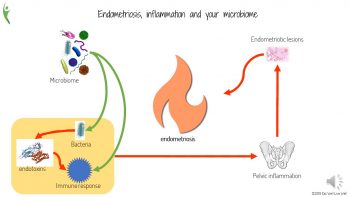
The bad bacteria produce chemicals, called endotoxins. The endotoxins trigger the immune system. We know that women with Endometriosis have an ‘excitable’ immune system, making it react, and overreact, to harmless triggers.

The immune system is our focus for September, so we’ll delve deeper into it next month. But at this point it is important to realise that one of your immune system’s key response is to create inflammation. And in the case of endotoxins, it’s not a localised, acute inflammation you would get with a small wound on your hand, for example, but a systemic (wide-spread), chronic inflammation, affecting a wide range of organs and tissues.

In your gut, this inflammation creates and worsens a leaky gut, where the gut wall allows undigested food particles to go through and enter the blood stream. Which triggers the immune system, creates more inflammation … you can see the vicious cycle.

When the organs in your pelvic cavity get inflamed as well, they become perfect areas for endometrial tissue to settle and grown.

The lack of good bacteria also contributes by creating an environment where bad bacteria can flourish.  Certain good bacteria like those of the lactobacillus family, help to increase the pH in your gut as well as in your endometrial tissue, making it very difficult for the bad bacteria to survive.

So a healthy microbiome affects your endometriosis by keeping the pH high to make it difficult for bad bacteria to thrive, and with less bad bacteria, your immune system will be calmer. A calmer immune system means less inflammation, and that means it’s harder for endometrial tissue to ‘settle’.

Next week I will give tips on how to start changing the balance of the bacteria in your microbiome with food.

And here are links to the previous posts in this month’s theme:

Typical bacteria found in the microbiome of women with endometriosis

Last week I explained what the microbiome is: the balance of good and bad bacteria. If you missed the post, you can read it here.

This week, I’d like to share with you what we know about the microbiome for women with endometriosis. Because their microbiome differs from other women and this has a direct impact on the progression of endometriosis.

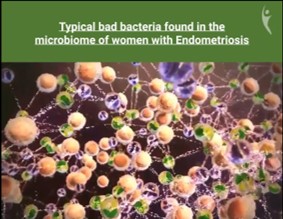
Women with endometriosis have been found to have more E. coli/Shigella in their gut microbiome, their vaginal microbiome and even in the endometrial tissue.

Bacteria like E.coli/Shigella produce endotoxins that trigger an immune response that leads to inflammation.

Increased inflammation is the perfect environment for endometrial tissue to attach itself to organs in your pelvic cavity.

Women with endometriosis have been found to have less lactobacillus strains in their gut microbiome, their vaginal microbiome and even in the endometrial tissue.

Bacteria like lactobacillus produce lactic acid, which lowers the pH and makes it difficult for many bacteria (the ones we don’t want) to survive.

So low levels of lactobacillus increase the pH (in your gut, in your vagina and within the endometrial tissue), creating a wonderful environment for bad bacteria to thrive.


Next week we will explore how the typical microbiome of women with endometriosis impacts the progression of your disease.

Have you joined the 'Using Nutrition to Manage Endometriosis' Facebook group yet? It's a supportive community of women with endometriosis where you can find tips, ideas and strategies for all sorts of symptoms.

You can join here.

The Microbiome in Endometriosis – what is it?

You hear the term everywhere at the moment: ‘Microbiome’. It’s very popular with advertisers, so you may be wondering what it is. Is it something real or a fancy marketing term? Is it good? Is it bad? What does it do?

Time to get some clarity on it, as, yes it is real, and because it has a major impact on your endometriosis.

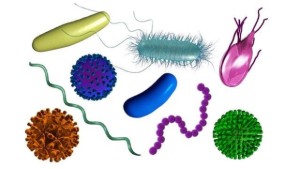
In the most simple terms: microbiome is the combination of all bacteria. Bacteria on you (your skin) and in you (your gut).

We used to think bacteria were all bad, and getting rid of them from within us, on us and around us was a good thing to do.

Now we know that we are host to trillions of bacteria and that without them we wouldn’t survive!

For example, you have a microbiome on your skin. These bacteria play a key role in making sure that dangerous particles (all around us) can’t enter your skin.

You also have a microbiome in your gut; a balance of bacteria that are essential for digestion, your immune system and even emotions.

For Endometriosis, we are mostly interested in your gut microbiome and the microbiome in your pelvic cavity.

Each microbiome consists of good bacteria – the ones that help keep our body systems working well and keep us healthy – and bad bacteria – the ones that cause problems.

The reason we want to look at your gut microbiome is that we know the women with endometriosis have an altered microbiome: for some reason they have more bad bacteria.

Another reason to look at the microbiome is that nutrition is a powerful way to alter your gut microbiome.

Did you know that gut bacteria feed on what you eat?

Bad bacteria feed on different foods than good bacteria. Which is great, because by eating more of the foods that good bacteria like you can increase the number of good bacteria in your gut. And by eating less of the foods that bad bacteria need you can starve them.

Here is a good introductory video about the human microbiome: https://www.youtube.com/watch?v=5DTrENdWvvM

In next week’s post I will go into more detail on the bacteria that make up the microbiome in women with endometriosis.

If you have any questions about what the microbiome is, post them below!

Chocolate and endometriosis: not a match made in heaven

How often have you said "I neeeeeed chocolate!" - with a groan, in desperation ..

When we're tired, moody, or just feel like a pick-me-up, chocolate is often the go-to snack.

And with so much information out there that chocolate is a great source of healthy antioxidants, why not?

Well, if you have endometriosis you may want to reconsider. It may be making your endometriosis worse for 2 reasons.

1 - Sugar.

Most chocolate contains a lot of sugar, especially white and milk chocolate, and very little real chocolate. For example, the normal dairy milk chocolate from Cadbury's contains 14 grams of sugar per serving (4 squares, but who stops at 4 squares once you get going?). That is 3 teaspoons (or more)!!

Sugar is a known inflammatory food: it plays havoc with your immune system and increases your overall inflammation. And inflammation is at the core of your endometriosis. So ... more sugar means more inflammation .. means more endometriosis.

2 - Chocolate

Even if you go for low sugar, dark chocolate or even raw cacao, some of you may still making your endometriosis worse.

The cacao in chocolate contains histamine.

You probably know that when you have an allergy like pollen, your body produces histamine in response to the pollen particles. The results is inflammation in your nose, back of your throat, etc. Histamine is not just produced in response to an allergen, it is also found in many foods, including chocolate.

Some of you will have a histamine intolerance, which means that your body is super-sensitive to histamine. So it will respond to histamine in food with ... you guessed it ... inflammation.


Even if you don't feel that chocolate is a 'trigger food' for you (read this article about trigger foods and why it's not enough to just remove them from your diet) it is likely to still make your overall inflammation worse and as such, your endometriosis.


What could you have instead of chocolate for a pick-me-up? Try an apple or a banana or other piece of fresh fruit (except citrus). They provide great energy with some added nutrients that will help fight your inflammation.

Are you interested in finding out how nutrition affects your endometriosis, and how tweaking your diet can reduce the severity of your symptoms by up to 50%?
Then join me in a free live webinar:
"Why Nutrition Should Be A Key Strategy In Managing Endometriosis."
To find out more and register, click here.

Endometriosis and food – is it about triggers or is there more going on?

I work with women with endometriosis. I help them change what they eat and use nutrition to reduce the severity of their symptoms.

What I have noticed in the talk around endometriosis and food is that there is a strong focus on finding what the triggers are. Finding out what foods will lead to a flare-up. With the assumption that if you remove those foods your endometriosis symptoms will reduce.

Knowing what foods affect your endometriosis is absolutely important, but I think it’s even more key to look beyond triggers.

I’ll use an analogy to explain.

I have a nail sticking out of the doorway from my kitchen to the laundry. It’s been there for as long as I’ve lived here. Now let’s assume I keep getting caught on this nail and scratching arm each time I walk past it. The trigger for my injury is the nail in the doorway.

I know it’s there and if I put a bit of conscious thought into going to the laundry I can easily avoid it.

This is how trigger foods work with endometriosis: you know when you eat your trigger food, your endometriosis will flare up. With a bit of effort (or a lot, depending on how much you love your trigger food) you can minimise your flare-ups by not eating your trigger food.

Going back to my analogy, what if I do scratch myself on the nail, and as the wound tries to heal, I keep picking off the scab, causing it to get infected and not heal? I can avoid the trigger, the nail, all I want, it’s not going to help my scratch to heal. Instead, I would need to put something on the wound to disinfect, perhaps put a band aid on, etc.

Endometriosis is a chronic inflammation disorder. Your whole system is in a constant state of inflammation and your immune system is super-sensitive to anything that may look like an invader.

Your trigger food(s) will act like a fire-alarm for your immune system. But because of your inflammation, the fire-alarm will get triggered far to easily.

Removing your trigger food(s) will certainly reduce the strength of your immune system’s response, but it won’t deal with the underlying inflammation.

There will be foods that are not triggers for your endometriosis but will contribute to your overall inflammation.

And there are foods that can help reduce the overall inflammation.

Now let me make one thing clear: nutrition can not cure endometriosis. But you can feel so much better if you do more than just remove your trigger foods.

If you’d like to know more, get in touch! Or check out my program: Using Nutrition to Manage Endometriosis.

How a friend’s endometriosis story led to a new program

Let me introduce Linda (not her real name and photo, but a real person in my life who shared her story with me but wanted to remain anonymous).

When she was in her early 20s and studying at Uni, she had terribly painful periods. She went through a box of painkillers each period, and they often didn't do much.

Over time, her periods started to get heavier as well, until she had to change her pad and or tampon every hour.

In her 30s, her partner noticed that her stomach was quite distended. After GP and gynaecologist appointments she ended up in hospital for a laparotomy to remove 2 endometriomae the size of mangos.  They were stuck to her uterus, and her uterus was stuck to her back.

After the surgery, she tried to fall pregnant, but was unsuccessful until IVF treatment, which gave her and her husband a beautiful girl.

Not long after the birth of her daughter she needed another operation to remove more endometriomae, a bit smaller this time. But her heavy periods remained until she had a mirena inserted.

Then she read about endometriosis and diet and started to experiment.

She removed gluten from her diet first, then alcohol and fried foods. And she saw an improvement in pain and less bloating.

Removing coffee and sugar then improved it even further. And she is now determined to stay on her self-created diet. A diet that took her 10 years to work out, without really knowing why some foods make her endometriosis worse and others better.

Hearing her story really resonated with me. Because I know why removing certain foods from her diet made her endometriosis symptoms less! And with professional nutritional knowledge she could have achieved her current manageable endometriosis so much sooner.

As we were talking she suggested a program like this. She said she'd felt so lonely throughout and having to do her own research (on Mr Google, not always the most reliable source) and experimentation was confusing and frustrating.

Now I don't have endometriosis, so I can't use my own personal experience as the basis for my support to you. But I can help you find the diet that helps you manage your endometriosis better, make you feel better, with less pain, heavy bleeding and bloating. By giving you scientifically tested information, and a process to discover what works for you.

Will it cure your endometriosis?

No.

But it will help you to develop a healthier immune system which slow down the growth of endometriosis and possibly the spread of the tissue.

Ready to learn more about Endometriosis and try a nutrition approach to manage your symptoms?

Find out how.

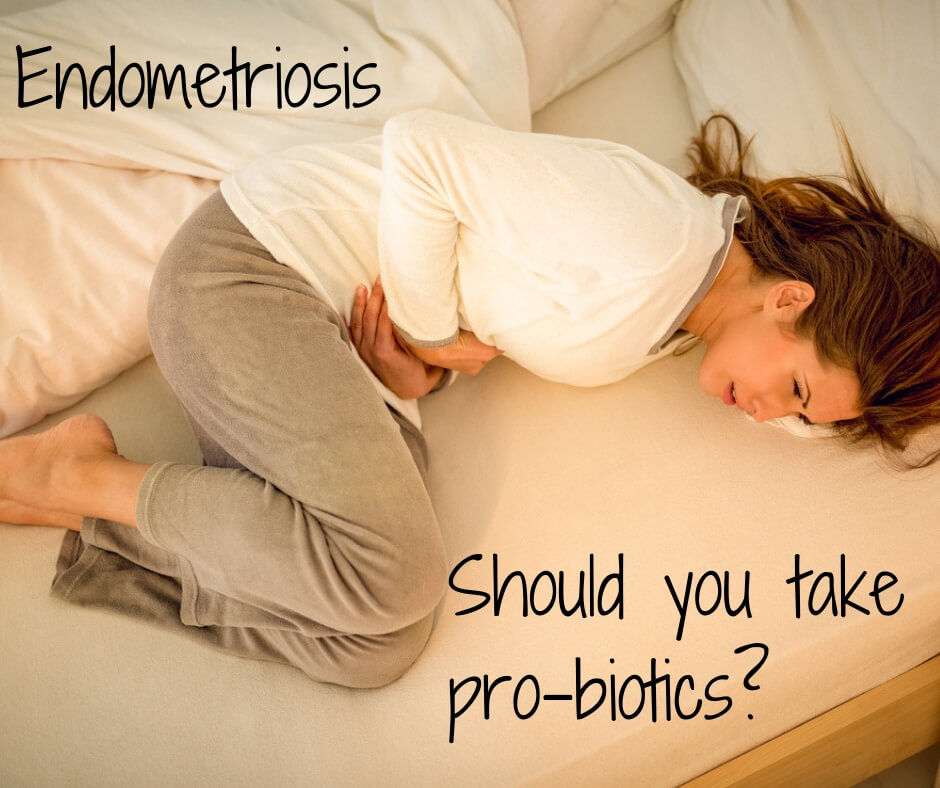
Endometriosis – should you take a probiotic?

Over the past couple of weeks I’ve discussed endometriosis as an inflammatory condition. To help your body fight the inflammation, a probiotic can be very beneficial.

So which probiotic strain could you try?

There is evidence that a lactobacillus gasserii works well to assist in improving your microbiome and combat the inflammation.

You can also try lactobacillus reuteri or planterum, or a probiotic with all 3 strains.

You can take the probiotic orally, rectally or vaginally, and the best time to do so is just before bed.

Do you use probiotics in your management of endometriosis? What are your experiences with it?


should you

Do you, or someone you know, have endometriosis and would like to see if changing what you eat will improve your symptoms?

I’m looking for a small group of women to test-drive a new program: Using Nutrition to Manage Endometriosis.

Endometriosis and your immune system

Endometriosis has a connection with your immune system.

Women with endometriosis:

  • have less natural killer cells
  • release too many cytokines in the presence of certain bacteria
  • produce more antibodies
  • produce more lymphocytes in the pelvis, but they are less active

Women with endometriosis also have more bacteria like eColi in their pelvic and urinary system. Traditional medication for endometriosis increases the activity of these bacteria, making your endometriosis worse.

So, what does that mean to you if you have endometriosis?

Your microbiome regulates your immune system, so by improving your microbiome, you can help you immune system function better.

Your first step could be to remove anti-inflammatory proteins from your diet: gluten in particular (removing gluten from the diet has shown an improvement in 75% of women with endometriosis).

You could also either remove dairy altogether, or switch to A2 dairy (goat and sheep) – especially if you had recurring upper respiratory infections as a child.

Try for a couple of cycles and see if you experience a reduction in pain.

Have you removed gluten and dairy from their diet and seen an improvement in your endometriosis?

Did you miss the previous post on endometriosis? Here it is:

Why exercise doesn’t necessarily make you healthier

She half-jokingly reasoned that since she was going to burn of some calories that day, it would be okay to eat something high in calories.

We make these trade-offs all the time, and it makes us feel better about both the exercising and the snacking.

And if your approach to health and being healthy is about calories and weight loss – or keeping the weight where it is – than this kind of thinking makes sense.

But weight loss and health don’t necessarily go together. I’ve written about that misconception here.

The same goes for fitness and health. Just getting fitter does not necessarily mean you’re getting healthier.

So why is that?

Firstly, let me make it clear that I absolutely believe we all need to move more. Our bodies are built for standing, walking and running. Not for sitting! Sitting is often referred to now as the new smoking. This article by the Victorian government explains the impact of sitting: https://www.betterhealth.vic.gov.au/health/healthyliving/the-dangers-of-sitting

So if you’ve decided to get fit, perhaps by walking more, going for regular swims, working out in the gym, doing dance classes, playing tennis, whatever you chose, fantastic!!

But if that’s all you’re doing towards better health you may actually go backwards.

Yes, backwards!

You see, when you up your physical activity levels, your nutrition needs change.  To help your body deal with the increased demands, it needs more of the good stuff.

More plant-based food (fruit, vegetables, seeds, nuts, wholegrains), better quality protein (meat, chicken, fish, dairy, pulses, legumes), and fats (olive oil, nuts, seeds, oily fish) to support:

  • the muscle strengthening,
  • the increased work your heart and lungs need to do,
  • as well as your increased metabolism.

Not more food! Just better food! Non-processed, home-cooked, natural whole food.

So how are you going to support your hard working body in it’s attempts to get fitter?