Adenomyosis

It’s about time I wrote about Adenomyosis because I know that quite a few of you either have both Endometriosis and Adenomyosis, or just Adenomyosis.

With Endometriosis, there is endometrial-like tissue outside the uterus, often on the ovaries, outside of the uterus, the bowel, the bladder, and other organs and tissues in the pelvic or abdominal cavity. You can have a wide range of symptoms, from pain to cysts to digestive issues.

So how is Adenomyosis different? Well, the main difference is the location of the endometrial-like tissue.

The wall of your uterus contains a very strong muscle that helps to shed the endometrium when you have your period and creates the contractions when you’re giving birth. When you have Adenomyosis, endometrial-like tissue has somehow started to grow on this muscle in the uterine wall.

As with Endometriosis, this tissue responds to hormone levels, and in particular oestrogen levels. When it is time for your period the endometrial-like tissue shed and bleed, just as the tissue inside your uterus.

But where the tissue inside your uterus has an exit route, the tissue in your uterine wall doesn’t. So you shed and bleed into your uterine wall, which can be excruciatingly painful. The spasming of the muscle also causes pain because the tissue that sits on it makes the muscle less flexible and makes that spasming more painful.

Now, as with Endometriosis, we don’t really know what’s causing Adenomyosis, so there’s not much in the way of a cure yet.

What we do know is that inflammation is also a factor that’s where an anti-inflammatory diet can help to relieve the pain and reduce any other symptoms you may have. Please know though that pain is difficult to get on top of. (If you’d like to know a bit more about pain, read ‘The advanced guide to managing pain’).

To make your diet more anti-inflammatory, remove all processed foods, sugar, caffeine and alcohol, and gluten and dairy products. Eat more fatty fish like salmon, tuna and mackerel. Eat a mostly plant-based diet with small amounts of high-quality meat.

If you want to take it a step further, work out what your personal food intolerances are and remove those from your diet as well.

If all this feels a bit overwhelming you can book a free Endometriosis SOS Call where we can have a chat about your symptoms and what your options are for using nutrition.

Book your Endometriosis SOS Call here.

Using Artificial Intelligence to plan your meals

A couple of months ago I was in a consultation with a client and we had been talking about how helpful it is to plan your meals weekly so you don’t have improvise. Changing your diet is hard because a lot of what we eat and when is habituated, meaning you don’t really have to think about it, you make your meals on automatic pilot. If you don’t have a system to follow to implement your diet changes, you’ll keep falling back on old habits.

Anyway, my client told me that she had started to plan her meals using an artificial intelligence (AI) tool. I thought that was so clever! I have a small set of meals that I recycle and I get bored of them, but I’m not good with creating meals from scratch (I hate cooking ☹) so I any help to take the thinking about what to eat out of the planning works for me!

So I thought I’d try it for myself and share with you what the results were so you can decide if this an approach you want to use to plan your meals.

Now I used Chat GPT, but there are various artificial intelligence tools out there so pick the one you like best.

Using an AI tool is a bit similar to doing a Google search in the sense that you type in a question and the tool provides answers. But what is so great about an AI tool is that you can keep refining the results by asking more questions.

Let me demonstrate what I did.

My first question was: “Can you please give me a seven-day meal plan that is gluten and dairy free?”

For day 1 the suggestions were:

  • Breakfast: scrambled eggs with sautéed spinach and cherry tomatoes.
  • Lunch: grilled chicken salad with mixed greens, cucumbers, carrots, and balsamic vinaigrette.
  • Dinner: baked salmon with roasted asparagus and quinoa.
  • Snack: fresh fruit salad.

Now if you are vegetarian or vegan or follow any other type of diet, I suggest you put that in your first question. I like to have at least 4 meat-free days in my weekly meal plan, so I then asked: “Can you make this meal plan with 4 no-meat days please?”

This is where it went a little pear-shaped, because it now gave me a completely meat-free meal plan.

I now wanted to see what would happen if I left out a specific food – mushroom in this case, because my daughter is intolerant to mushrooms. The question I asked was: “Can you please update this to make it mushroom-free?”

Strangely enough, the portobello mushroom burgers were still in the meal plan! But when I asked to replace the portobello mushroom burger it suggested a mixed vegetable burger.

My last question was for recipes for the meals in the meal plan and it gave me some links.

All in all, I was quite pleased with the results though. I now have some simple new recipes to try out and the ‘conversation’ I had with the AI tool stays in my account, so I can always come back to it and either further refine my request or just look at the results.

So, if like me, you know that it would be really helpful to plan your meals but you’re a bit stuck or bored with the meals you always make, try an AI tool to give you some new suggestions and plan your week for you.


If you’d like to learn more about how to adjust your diet to help reduce your Endometriosis symptoms, download my free report: “5 Things your eat and drink that make your Endometriosis symptoms worse”.

Pros and cons of taking supplements

You may have considered, or are already taking supplements. But have you considered the pros and cons of taking supplements?

Often, when you go see a doctor for a specific health complaint, you walk away with a medication prescription, a pill to take to make you feel better. And as a society, we’re quite enamored with pills and supplements. So, when it comes to managing your Endometriosis symptoms naturally, should you take supplements?

Well, it depends. Let's look at the pros and cons of taking supplements.

Pros of taking supplements

Supplements can play an important, temporary, role in improving your health and reducing your Endometriosis symptoms, but the operative word there is ‘temporary’.

My philosophy is that food should be your main strategy. Changing what you eat and drink is a sustainable strategy, one that you can stick to for the long haul.

Sometimes though, you need a bit of a ‘jump start’, especially when you have nutrient deficiencies, for example for iron or B vitamins.

Nutrient deficiencies can occur when your digestive system doesn’t function optimally, and your are not absorbing nutrients as well as you should. And because of your Endometriosis, the need for certain nutrients is higher than in healthy people. Or your diet is low in certain nutrients, or at least too low for your extra needs.

Supplements are also very useful if you need help with specific symptoms, and you need a therapeutic dose.

In these cases, addressing nutrient deficiencies through food alone would mean they’d have to eat enormous amounts of certain foods and it would take a long time to tackle the deficiencies. Supplements can be a good way to boost the effects of the changes in diet.

Supplements contain high concentrations of certain nutrients, for example iron or vitamin B and by taking them regularly you give your body that extra boost, that jump start that will help you to see results much faster.

Cons of taking supplements

But supplements are not harmless. For many vitamins the body can build up an excess and this then produces unwanted side-effects and symptoms which are often the same as the deficiency symptoms for that nutrient.

Also, please don’t rush out to the chemist or supermarket or go online to buy a range of supplements!

Firstly, because not everyone needs the same supplements: your unique health situation will be underpinned by a unique set of nutrient deficiencies.

And secondly, because the supplements you buy in the supermarket, the chemist or online are not therapeutic supplements. They are produced for the masses, will contain standard amounts of the nutrients that are so low that it is difficult to ‘overdose’ but also don't really help much. And of even more concern, they often have unwanted fillers and additives.

So what's the verdict?

It is important to get trustworthy advice on which supplements will be most beneficial for you based on your unique set of symptoms, and then to take supplements that are ‘Practitioner Only’ to guarantee you get a therapeutic dose of a high-quality nutrient. The supplements should be prescribed based on a full, in-depth health analysis by someone qualified to do so. Really the same as how medicine is prescribed by doctors!


If you'd like to have a chat about your Endometriosis symptoms and what your options are to use nutrition (diet and supplements) to reduce the severity of your symptoms, book a free Endometriosis SOS Call.

How to get enough calcium from your diet if you’re cutting out dairy

One of the key strategies I recommend to reduce your Endometriosis symptoms is to remove dairy from your diet (read more about why here). But for most of us, dairy is our main source of calcium in our diets, and you may be worried that without dairy, you won’t get enough calcium.

So in this article I’ll explain the importance of calcium and how to still get plenty of this important mineral from your diet even if you don’t have diary.

Let’s start with why we need calcium.

You probably know that it is a key mineral for bones, and not just for children who are still growing. Bone tissue is constantly renewing and for that your body needs a constant supply of calcium. But it is also needed for muscle function (it helps the muscles to contract), nerve function, blood clotting and regulating blood pressure.

Calcium from your diet gets stored in your bones and teeth. And when you’re not getting enough calcium from your diet, vitamin D gets activated to stimulate your gut to absorb more calcium from your diet. Your kidneys also start to reabsorb calcium and that triggers your body to start releasing more from your bones. That can’t go on for long of course.

So it is crucial that your diet provides you with all you need of this important mineral.

Now when we look at food sources, we need to look at how much calcium they contain, how easy your body absorbs it from the food and what other foods may interfere with absorption.

There are many non-dairy foods that are high in calcium: tinned fish with bones in, such as sardines and salmon; lentils and beans; dark green leafy vegetables, including Asian leafy vegetables; almonds; sesame seeds; parsley; and globe artichokes. A somewhat odd but excellent source is eggshells. Cleaned and pulverised it can be added to smoothies, sauces, and stews to really up your calcium intake.

But just because a food is high in calcium doesn’t mean all of it gets absorbed. The bioavailability is from foods like broccoli, cauliflower, watercress, Brussels sprouts, kale and bok choy is actually higher than dairy: 50% compared to 30%!

The third factor that impacts how much calcium you get from your diet is that some foods make it more difficult for your gut to absorb it:

  • Food that contain phytates, such as nuts and seeds
  • Foods that contain oxalates, such as beetroot, rhubarb, spinach, and sweet potatoes
  • Foods high in phosphorus, such as Brazil nuts, tuna, dried fruits, and corn.

Now, please don’t stop eating these foods! They contain important nutrients. But don’t each them in large amounts, and try not to eat meals that have a range of them together with foods high in calcium.

A fourth key factor in managing your calcium levels is vitamin D, which is needed to absorb it in the gut. Most women with Endometriosis are vitamin D deficient, so make sure you get plenty of sunshine (read more about Vitamin D here).

Perhaps, by now you’re thinking this is all too complicated, why not just take a supplement, and I’ll just take a high dose and be done with it. Before you run out to buy a some over the counter or online, you need to know a few things.

Firstly, calcium functions in tandem with magnesium so you need one with both. Secondly, what the calcium is bound to is important for absorption. There are many different compounds used for binding, but the best absorbed that gives the least gut irritation is calcium carbonate. And the third thing to consider is dosage. Many supplements come in a high dosage and seem convenient but don’t actually give you enough. A lower dose, 300mg with each meal is much more efficient.

Removing dairy from your diet doesn’t mean you can’t get enough calcium. Add lots of leafy green vegetables to all your meals (breakfast, lunch, and dinner) and only eating small amounts of the foods that make absorption more difficult.


Would you like to have personal chat about your Endometriosis and how nutrition can help you to reduce the severity of your symptoms? Book a free Endometriosis SOS Call now!

How inflammation affects your fertility and how diet can help

If you are reading this article you may already be worried about how your Endometriosis affects your fertility. And Endometriosis definitely has an impact on your fertility.

If you’ve been reading my articles, you’ll know that Endometriosis is an inflammatory disease. So in this article I want to delve a bit deeper into how this inflammation affects your fertility and how you can use your diet to reduce it.

So what role does inflammation play in your fertility? Well, in two roles: an indirect and direct role.

Inflammation plays an indirect role in your fertility because it drives the growth and spread of Endometriosis (if you’re not sure how inflammation is the ‘engine’ behind your Endometriosis, this article explains it) and Endometriosis reduces the quality of your eggs which can lead to chromosomal abnormalities that increase the chances of your embryo not being viable.

Endometriosis also affects your ovulation. Endometriosis on your ovaries or Fallopian tubes may block the release of an egg and make it impossible to enter the Fallopian tube. Endometriomas (or chocolate cysts) on your ovaries cause local inflammation which directly affects the quality of your eggs. They also reduce blood supply to the follicles and that reduces their growth.

Your inflammation even affects your partner’s sperm as it enters your vagina by damaging the sperm’s DNA.

Inflammation has a direct impact on your fertility as well. Recent research has shown that chronic systemic inflammation is associated with implantation failure of embryos. Women with Endometriosis have high levels of immune cells responsible for creating inflammation in their endometrium which makes it difficult for an embryo to implant.

So if you know that you have chronic, systemic inflammation, and it affects your fertility directly and indirectly, how can you use your diet to improve your chances of falling pregnant?

Well, the first step is to remove processed foods from your diet. Processed foods contain ingredients to keep them looking fresh, enhance the taste, and enhance shelf-life, and most of these ingredients are highly inflammatory. Instead, eat a wholefood diet, so fresh fruit and vegetables and meat, and cook your meals from scratch.

The second step is to remove gluten and dairy from your diet. These are the most common food intolerances I see in my clients and removing these from your diet can noticeably reduce the severity of your Endometriosis symptoms, a good sign your inflammation is reducing.

And the third step is to support your immune system. You can find out more on how to do this in this article “Your immune system: its biggest challenge and what you can do to fix it”.


If you’d like to discuss how nutrition can help you to reduce your inflammation and improve your fertility, why not book a free Endometriosis SOS Call?

Why Googling ‘healthy eating’ could worsen your Endometriosis symptoms

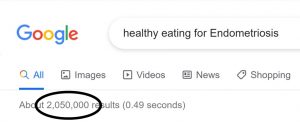
Before I started writing this article, I Googled “healthy eating for Endometriosis”. Would you like to guess how many search results that gave me? More than 2 million!

healthy eating for Endometriosis


There were book recommendations with diets and diet plans. And many webpages that tell you which food to eat and which to avoid. That was just on the first page ..

Many of the suggestions, at least on the websites I quickly clicked into, give very general healthy eating recommendations. The kind that most governments also provide for other diseases, for example heart disease. The recommendations are to avoid processed foods, eat more fruit and vegetables, avoid inflammatory foods (but the sites disagree sometimes on what is inflammatory and what isn’t), eat a wholefood, or FODMAP, or general anti-inflammatory diet.

Now, I don’t disagree with any of these. But I think there are a few reasons why the information on Google about healthy eating for Endometriosis at best confuses you and at worst make your Endometriosis symptoms worse.


1. The healthy eating recommendations are based on the writer’s view of what may be causing Endometriosis.

Some sites recommend an anti-inflammatory diet which means they see Endometriosis as an inflammatory disease. Others recommend foods to help your body to get rid of oestrogen. They work from the perspective that Endometriosis is a disease of excess oestrogen. And some recommend eating a diet to help balance your hormones, assuming your hormone balance is behind your symptoms.


2. Some books or websites are written by clinics or practitioners, others by people with a lived experience.

I would hope that clinics and practitioners base their advice and recommendations on well researched, scientific information. It is great to see that Endometriosis is getting more funding for research and that nutrition is becoming a topic of interest.

Other sources of information are written by people with a lived experience, so women who have Endometriosis, have searched for and experimented with different diet approaches and found something that improved their symptoms.

What both of these have in common though is that they don’t take the individual’s relationship with food into consideration. If a research study says a gluten-free diet reduces symptoms for 75% of women, that is a fantastic insight. But do you below to the 75% that will see an improvement, or to the 25% who don’t see a benefit from a gluten-free diet?

Similarly, if one woman shares her success with a particular nutritional approach, how do you know it will have the same effect for you?

Just because the diet changes made her feel better doesn't mean it will do the same for you. In fact, you could end up with worsening symptoms.


3. The majority of healthy eating information only looks at Endometriosis

When you search for healthy eating for Endometriosis, the results only look at Endometriosis in most cases. But what if you also have a thyroid problem? Or asthma? I couldn’t find any search results for combinations of health concerns, except for Endometriosis and PCOS.

If you have other health concerns, the recommendations may help you to reduce your Endometriosis symptoms, but may not help your other health concerns, or even make those worse!


4. The aim of the information is to appeal to a large audience

Websites and books try to provide information to a large audience, and need to generalise (just as I have generalised about the information I’ve found in my Google search on healthy eating for Endometriosis) to make the information readable.


5. Nutrition and your health is based on biochemistry

How nutrition affects your health is based on biochemistry – how compounds and molecules from food interact with your body and body systems. Unless you have some knowledge of the biochemistry of nutrients and health, you’ll be blindly trialling things. Some may make you feel better, others don’t make a difference at all, but you have no idea why.


Here's what I know about healthy eating for your Endometriosis. There’s only one way to eat healthy and reduce your symptoms, and that is to follow your uniquely personal diet. A diet that takes all your health concerns into consideration, and is based on your unique relationship (good or bad) with food.

Can you get create that diet based on Google results? Possibly. But you’ll get much better results and a lot faster and with a lot less confusion, if you let an expert help you to create that diet.


Has Google confused you about healthy eating for Endometriosis? I can help you get some clarity about how Nutrition may help you in a free 30-minute Endometriosis SOS Call.

Bowel movements: the importance of monitoring your number two’s

With the gut playing such an important role in your chronic inflammation and therefore your Endometriosis, your bowel movements are a powerful tool for monitoring your gut health.

Constipation, diarrhoea or alternating between the two are common Endometriosis symptoms. When you start to change your diet to help manage your Endo, it helps to develop the habit of monitoring your number two’s. And to be able to do that, you need to know a little bit more about the different types of bowel movements you can have, what healthy looks like and how the non-healthy ones affect your health.

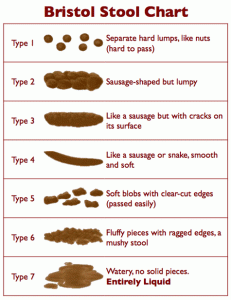
The Bristol Stool chart is a helpful tool to learn more about healthy and unhealthy bowel movements. To be able to monitor your number two’s effectively you need to monitor what your stool feels like and what it looks like.


Let’s start with what you are aiming for: a perfect stool! When you feel the urge you should be able to hold it until you get to the toilet without too much difficulty. Then, when you sit down it should take no effort to produce a long, smooth thin sausage. You shouldn’t need to strain to move the stool.

If you are more on the constipated side of the scale, your stool will have a thicker, shorter shape, and will take some effort to push out. The more constipated you are the more difficult it is to have a bowel movement and it can be quite painful as well. The worst type of constipation is when you produce little pellet-like stools.

Besides it being very uncomfortable to be constipated, it also has an effect on your health. If you are constipated, your stool can’t move through your gut at the speed it should and ends up just sitting there. Your faeces is made up of all sorts of waste products, not just food related, but also by-products of various body processes, dead cells and hormones. If it stays in your colon, your body starts to re-absorb these toxins.

On the other side of the scale is diarrhoea.  You won’t need to strain to have a bowel movement, but the more watery the stool is the more difficult it will be to hold in.  The problem with diarrhoea is that it moves through your system too quickly and you can’t absorb enough nutrients from your diet.

If you develop the habit of quickly assessing your stool each time you go, you’ll be able to notice when something is off. Your diet plays a key role in your bowel movements, especially food intolerances. But stress, not enough fluids or being sick also affect them.

If you’ve had a healthy stool for a while and suddenly you’re constipated or have diarrhoea, you can take this a warning sign: did you eat something that you know you’re intolerant too? Or are you going through some stressful times?

Developing a habit of quickly checking your stools each time will give you a simple and powerful tool to keep an eye on your gut health.


If you suffer from constipation or diarrhoea regularly and would like to chat about how nutrition can help, you can book a free 30-minute Endometriosis SOS Call: https://theendometriosisnutritionist.online/endometriosis-sos-call/.

Fighting the odds: Shelley’s pregnancy success story

Endometriosis affects fertility but that doesn’t mean that there is no hope. Nutrition can be a powerful tool to improve your chances of falling pregnant, and Shelley’s story is a good example.

She came to me at the end of 2021, and she had just one focus: she wanted to improve her changes of a pregnancy. She was in her mid-thirties and had endometriosis, including Endometriomas (chocolate cysts on her ovaries). She also had pain in her chest and in her legs. And she really struggled with her moods, especially around her period. She was already going through IVF and was looking for things she could do herself to improve her odds.

In her first consultation we talked about her goals and her symptoms and then we looked at her diet. She had done a food intolerance test and that showed that she was intolerant to some normal, healthy foods, such as dairy (like most of my clients), almonds, chickpeas, apples, chicken, coconut, mushrooms and green beans.

Now, normally, to improve fertility, we look at 2 things: improving egg quality and reducing inflammation. In Shelley’s case the immediate focus was not on improving egg quality because she still had a frozen embryo and was a few weeks out from its transfer.

So the immediate goal was to reduce her inflammation to reduce the risk of implantation failure. Inflammation has been shown to be a key factor in an embryo not being able to implant and reduce your chances for a successful pregnancy.

We looked at her current diet and then tweaked it to remove the foods she was intolerant to. I also prescribed her a probiotic to improve her gut microbiome and after her initial consultation she went off and tried very hard to stick to her new diet.

In her next appointment 2 weeks later she was doing really well. She had implemented most of the changes to her diet and had increased the amount of fruit and vegetables she ate. One of the things she found most difficult was what to eat instead of chicken, as that had been a protein staple. As an alternative we discussed turkey and I also recommended she add more fish into her diet. Fatty fish in particular is an important element of an anti-inflammatory diet as it contains omega 3 fatty acids (read more about that here).

Her next appointment was just after her embryo transfer, so she was in that terribly stressful 2 week wait period. We discussed some ways to manage that stress and also how she was doing with her diet. She found eating more fish instead of chicken was a good option. She also shared that she’d ‘fallen off the wagon’ at a birthday party and had eaten some of the foods she was intolerant to and had felt awful afterwards, with lots of bloating and other symptoms returning. To be honest, I’m always happy when that happens because it often causes symptoms to come back and that provides powerful evidence that the new diet is doing good.

We had booked her 3rd appointment and when she rescheduled it I wasn’t sure whether to be worried or get a little bit excited .. Well, turns out she was pregnant! She had changed the appointment to be after her pregnancy test.

So we now changed focus of course to dealing with some nausea and how to make sure her first trimester went well.

I wanted to share Shelley’s story with you to give you an idea what it would look like to use your diet to improve your fertility and also to give you some hope that pregnancy is possible despite your Endometriosis. Now I obviously can’t say that the work we did together was the one thing that got her pregnant, but it will have reduced her inflammation. And she found the fact that there was something she could do herself to improve her chances reduced her stress.

Now, the strategies I describe using with Shelley were personalised to her and her unique health situation. They are not generic. What I recommended to her I may not recommend to someone else. What worked for her may not work for you.

Perhaps reading Shelley’s story makes you wonder how nutrition may be able to help you to increase your chances of a successful pregnancy. I have a free guide “5 Strategies to improve your fertility naturally when you have Endometriosis”.

If you’d like to discuss your options with me, book a free 30-minute Endometriosis SOS Call.

When should you start to work on your fertility?

When you have Endometriosis, your fertility will be affected. It doesn’t automatically mean that you will be infertile, but you are likely to find it more difficult to fall pregnant.

But the good news is that nutrition can help to improve your fertility! But when is the best time to start working on your fertility?

Well, that depends on where you are in your fertility journey:

  1. Are you already trying?
  2. Do you plan to start trying in about 6-12 months?
  3. Do you know you would like to have children at some point, but not anytime soon?

Your approach and when to start is slightly different for each.

1.      You are already trying

If you are already trying, whether naturally or using assisted reproductive services, the time to start is now! And there are 2 things you need to focus on.

The first focus should be on reducing your inflammation. Endometriosis is an inflammatory disease (read more about that here), and it is the underlying chronic inflammation that provides the ‘fuel’ for it to spread and progress. We also know that inflammation is also a major cause of implantation failure. And what you eat  Your personal Endometriosis diet needs to be anti-inflammatory, which means not only eating a range of anti-inflammatory foods, but also removing any foods that you are intolerant to.

The second focus should be on improving the quality of your eggs, and this requires some specific supplements. Endometriosis directly affects your eggs’ ability to produce the energy they require to mature and support the development of an embryo. This is especially important if you are over 35.


2.      You’re planning to start trying in 6-12 months

If you are planning to try for a baby in the next 6-12 months, I recommend you start with reducing inflammation right now. Find out what your personal Endometriosis diet is and take a few months to establish it – changing your diet can be difficult! Then, when you’re about 4 months out from starting your fertility journey in earnest, you’ll need to start working on your egg quality with supplements. Your eggs take around 3-4 months to go through their maturing process and this requires a lot of energy. Endometriosis affects your eggs’ ability to produce energy and supplements are needed to make sure they function as they should to minimise the risk of chromosomal abnormalities.


3.      You want children at some point but not anytime soon

If a pregnancy is not on your immediate horizon but you know that you want children at some point you could wait until you’re about 6-12 months out from trying. But my recommendation is to start now on reducing inflammation by finding your personal Endometriosis diet. It will have a few immediate benefits plus you know you’ll be getting your body in the best state possible for when you want to try to fall pregnant.

By finding the right diet for you now, you’ll be able to start reducing your inflammation. You can take your time to make the changes you need to make and establish some good routines around what you eat and don’t eat. And you’ll see many, if not all, of your Endometriosis symptoms reduce! Then, when you are about 6 months out from starting your fertility journey, you need to think about improving your egg quality and start taking some specific supplements.


So, wherever you are in your fertility journey, there are things you can do right now to improve your fertility.

June is World Infertility Awareness Month, and I will be running an online workshop where I go into everything I’ve discussed in this article in a lot more detail.

The workshop is called “How to improve your fertility naturally when you have Endometriosis” and I’m running it on Saturday 10 June (Sydney Australia time zone). I’ll be running the workshop twice that day to accommodate the different time zones in the world.

Find out more and register now! https://www.subscribepage.com/improve-your-fertility-when-you-have-endometriosis-june-2023

Endo-friendly foods to reduce Endometriosis symptoms naturally

Endo-friendly foods are foods that help you reduce your chronic, systemic inflammation (if you'd like to find out how inflammation affects your Endometriosis, watch this video). They are the foods you should try to eat more of and add to all of your meals as much as you possibly can.

Antioxidant rich foods

Let me start by explaining what antioxidants do. It’s a term you hear a lot of, but not many people know what they are or do.

Certain foods, stress and less than optimum health are all factors that create free radicals. Free radicals are like a gang of aggressive hooligans, running around your body, damaging cells and tissues, and causing inflammation in their wake. Hmm, inflammation, again!

Antioxidants are like police officers, very good at catching those hooligans, slapping the handcuffs on and escorting them off the premises – i.e. your body.

If you eat a diet high in antioxidants, your body is able to remove the free radicals very effectively, reducing the unnecessary inflammation.

Endo-friendly foods that are high in antioxidants are:

  • Red/orange vegetables: Carrots, sweet potato, red capsicum/peppers
  • Green vegetables: broccoli, Brussels sprouts, cabbage, Spinach
  • Fresh fruit, especially high in vitamin C: kiwi, citrus, guava
  • Seeds and nuts


Omega-3 fatty acids containing foods

In a study of more than 70,000 nurses in the US showed that the amount of fat you eat doesn’t impact your risk of endometriosis, but the type of fat does.

Omega-3 fatty acids are known to help reduce inflammation. Endo-friendly foods that contain Omega 3 fatty acids are:

  • Fatty fish, like salmon, tuna, mackerel, herring, sea mullet, redfish, flounder, trevally, tailor, Sydney rock oyster, blue mussel, rainbow trout, and whiting.
  • Oils: flaxseed, hempseed, canola
  • Nuts: especially walnuts.

Try to eat fish twice a week and have a handful of nuts and seeds twice a day.

Fibre

Fibre plays an important role in removing excess oestrogen from your body. It can attach itself to oestrogen, and then help remove it from the bowel.

Endo-friendly foods high in fibre are:

  • Apples
  • Oats (but check they are truly gluten-free)
  • Fruit such as berries, pears (skin on), melon and oranges.
  • Vegetables such as broccoli, carrots and sweetcorn.
  • Peas, beans and pulses.
  • Nuts and seeds.
  • Potatoes with skin on.


By adding foods that are high in anti-oxidants, contain omega 3 fatty acids and are high in fibre, you provide your body with key nutrients to reduce your inflammation.


If you'd like to have a chat about how nutrition can help you reduce the severity of your Endometriosis symptoms, book a free 30-minute Endometriosis SOS Call.